Day 1 of the first Test between India and Sri Lanka in Galle witnessed a scary moment as KL Rahul 's shot struck Nishan Madushka on the helmet. After winning the toss, India skipper Shubman Gill opted to bat first as the visitors began their 600th Test match. Openers KL Rahul and Yashasvi Jaiswal looked in fine touch and provided India with a solid start. However, during the 10th over, bowled by Prabath Jayasuriya , Rahul's shot crashed into Madushka, leaving players and spectators stunned. On the fifth ball of the over, Rahul attempted a low sweep. Madushka, stationed at short leg, realised he was in trouble and tried to duck, but the ball struck the centre of his helmet. The impact immediately prompted Sri Lanka's team physio to rush onto the field. Seeing Madushka down, Rahul initially hesitated before taking a single, but Jaiswal had already crossed halfway down the pitch, leaving him with no option but to complete the run. Afterward, Rahul immediately went over t...
If you have been thinking about adding an electric cooktop to your kitchen, you have probably already run into the induction versus infrared question. Both sit behind a flat glass surface, both run on electricity, and both look almost identical on a kitchen counter. But they work in completely different ways, and for Indian cooking specifically (everything from a high-heat tadka to a slow-cooked dal, a deep-fry in a kadhai to a Phulka on a tawa), the differences matter a lot more than they would for a kitchen that mostly does pasta and scrambled eggs. Here is a proper breakdown of what each cooktop actually does, how it handles the demands of Indian cooking, and which one makes more sense for your home.
How They Work: The Fundamental Difference
This is the part most people skip, but it explains everything else.
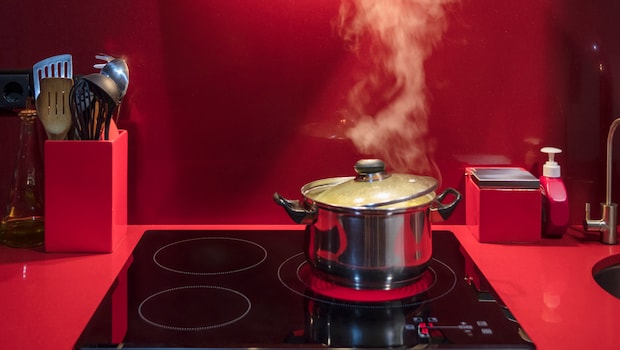
An induction cooktop does not generate heat in the cooktop surface itself. Instead, it uses electromagnetic energy to generate heat directly inside the base of the cookware. There is a copper coil beneath the glass surface that creates a magnetic field, and when a pot or pan with a magnetic (ferrous) base is placed on it, that magnetic field induces an electrical current in the metal, which produces heat. The cooktop surface itself stays largely cool. It only warms up from the residual heat transferred back from the hot pan. This is why induction is so energy-efficient: almost none of the energy is wasted heating air or the surrounding surface.
An infrared cooktop, on the other hand, works by heating the glass surface itself using a halogen lamp or a heating element underneath it, which then radiates heat upward into whatever vessel you place on top. It is closer in principle to a traditional electric coil stove, except that the heat is delivered more evenly and more efficiently. The surface gets hot, the vessel placed on it gets hot, and the food cooks. Simple and familiar.
The practical implication of this difference is enormous: induction only works with magnetic cookware, while infrared works with virtually any cookware that has a flat bottom.
The Cookware Question: The Biggest Practical Difference For Indian Kitchens
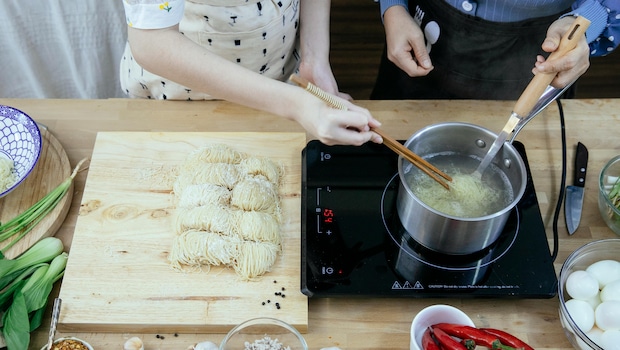
Photo Credit: Pexels
This is where most people make their buying decision, and it is the right place to focus.
For induction, the rule is firm: the vessel must have a magnetic base. The easiest test is a simple fridge magnet. Hold it to the bottom of your pan. If it sticks firmly, the vessel will work on induction. If it does not stick, it will not work at all. Induction-compatible materials include cast iron, carbon steel, enamelled iron, and stainless steel with a magnetic base. Most stainless steel pressure cookers and many newer stainless steel tawas and kadahis are induction-compatible.
What does not work on induction: plain aluminium, copper, glass, ceramic, and non-magnetic stainless steel. And here is the problem. The Indian kitchen is full of aluminium. The classic thin aluminium pressure cooker, the aluminium vessels that have been in the family for decades, the lightweight aluminium kadhai. None of these will work on an induction stove unless they have been specifically fitted with an induction-compatible base. For many households, switching to induction means buying a significant amount of new cookware, which adds to the upfront cost.
Infrared is considerably more forgiving. Because it heats the surface and the vessel receives that heat by contact, it can work with aluminium, glass, ceramic, and most flat-bottomed vessels. There is no magnetic requirement. If you have a wide range of existing cookware that you would like to continue using, infrared does not force your hand.
There is, however, one shared limitation that catches many Indian cooks off guard: both induction and infrared work best with flat-bottomed vessels. The traditional kadhai with its rounded base is genuinely problematic on both. On induction, a rounded-base kadhai will not be detected by the cooktop's sensor and the hob simply will not activate. On infrared, it will heat, but unevenly, because the curved base does not sit flush against the glass surface. For everyday deep-frying, the solution is the same on both platforms: use a heavy flat-bottom kadhai, or a wok-style vessel with a flat base.
Cooking Performance: Speed, Heat Control, And Indian Techniques
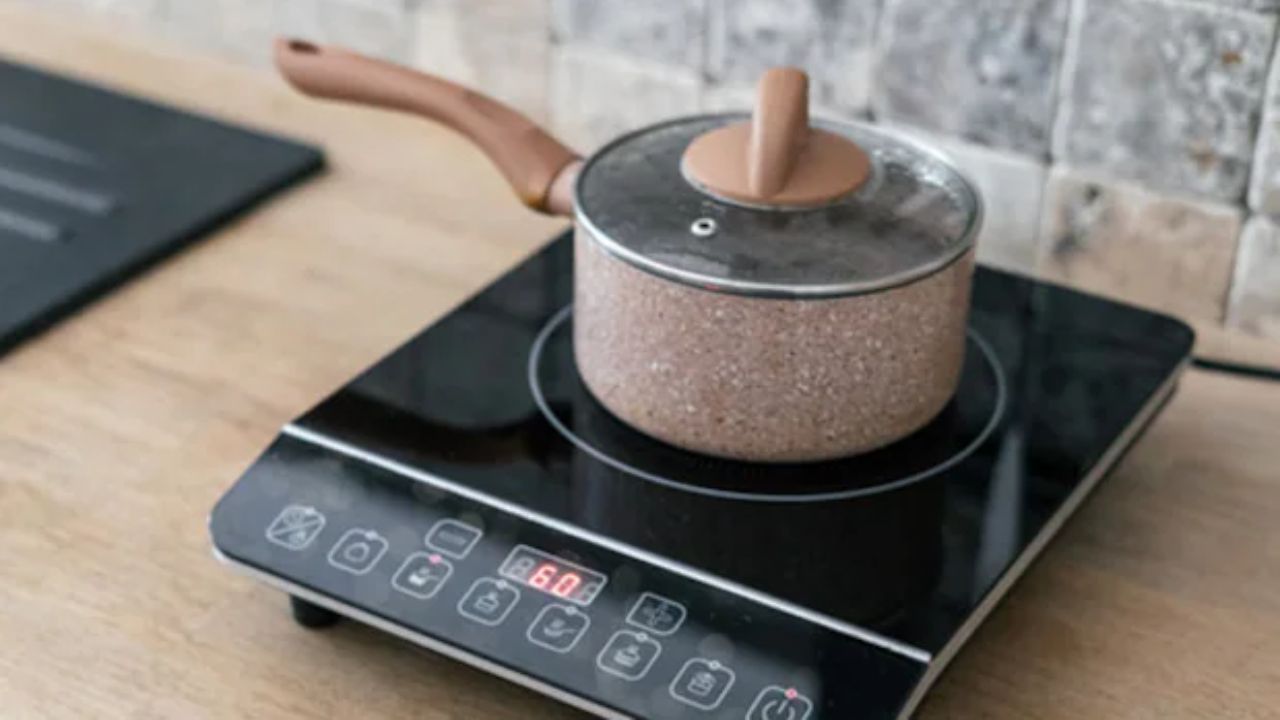
Speed and heat-up time: Induction heats up significantly faster than infrared because it generates heat directly in the cookware rather than heating through an intermediate surface. For tasks like bringing a pressure cooker up to full pressure, boiling water for rice, or getting oil to the right temperature for a tadka, induction is noticeably quicker.
Temperature control: Induction offers much finer temperature control. The electromagnetic field can be adjusted almost instantaneously, so dropping from a high sauté to a low simmer happens immediately and accurately. This is a real advantage for Indian cooking, where the difference between a perfectly done bhuna masala and a burnt one can be a matter of seconds. Infrared responds more slowly and retains heat in the surface for some time after the setting is reduced, which can make precise control harder.
Even heating: Infrared has a slight edge here. Because it heats the entire base of the vessel through radiant contact, the heat distribution tends to be more even across the bottom of the pan. Induction heats the centre of the base more intensely, which can occasionally create hot spots in certain types of cookware.
The tadka question: Both handle a quick tadka well enough, though induction's faster heat-up time and finer control give it an advantage when you need the oil to hit a specific temperature quickly, or need to drop the heat immediately after the mustard seeds splutter.
Phulkas and rotis: Neither platform replicates the direct flame of a gas stove, which is what allows a phulka to puff up fully. On both induction and infrared, rotis can be made on a tawa and will cook well, but the final puffing stage (where you would normally move the roti directly onto the flame) requires a workaround. A thick iron or steel tawa, pressed down gently on the roti, can help. Some cooks use a small wire mesh rack placed on the heating zone for the final puff. It takes some practice, but it is doable.
Baingan bharta and smoky dishes: This is the one technique that neither an electric cooktop can replicate. The smoky, charred flavour of a brinjal roasted over a gas flame is essentially impossible to achieve on induction or infrared. If baingan bharta is a weekly staple in your home, you will either need to finish on an oven grill, use an air fryer, or use the dhungar technique (placing a small piece of burning charcoal in the finished dish under a cover) to add smokiness.
Energy Efficiency, Safety, and Cost Considerations

Photo Credit: Pexels
Induction cooktops excel in energy efficiency, transferring up to 90% of generated energy directly into cookware, minimising ambient heat waste. In contrast, infrared cooktops, while more efficient than traditional electric coil stoves, still lose energy to the heated glass surface and surrounding area. Over time, these energy savings can significantly reduce electricity bills.
Safety is another area where induction shines, especially in households with young children or elderly members. The cooktop surface remains cool, reducing the risk of burns, unlike infrared surfaces that stay hot even after being turned off. Induction cooktops often include safety features such as child locks, auto shut-off, and overheat protection. Both induction and infrared are safer than gas stoves, which pose risks of gas leaks, carbon monoxide, and open flames.
Regarding cost, infrared cooktops are generally more affordable upfront, with entry-level models in India starting at ₹1,500 to ₹2,500, compared to induction models starting at ₹2,000 to ₹3,500. However, if switching to induction requires purchasing new cookware, the initial cost increases. Despite this, induction's long-term energy efficiency can offset the higher upfront expense, with potential monthly electricity savings accumulating over a year or two, making it a cost-effective choice for daily family cooking.
Which One Should You Buy?
Choose induction if you do most of your cooking in stainless steel or cast iron, you have or are willing to invest in induction-compatible cookware, you prioritise speed and precise temperature control, and safety is a priority in your household.
Choose infrared if you have a wide range of existing cookware that you would like to keep using (including aluminium), you are on a tighter budget, or you prefer a simpler, more familiar cooking experience that does not require checking whether your vessels are compatible.
There is no universally correct answer here, and that is actually reassuring. Both options are genuine improvements over older electric alternatives, and either will serve an Indian kitchen well once you understand the requirements. The honest truth is that most experienced Indian home cooks who have made the switch to induction end up preferring it after the initial adjustment period, largely because of the speed and the fine control. But infrared remains a practical, flexible choice, particularly for kitchens that run on a diverse mix of cookware accumulated over years of cooking. Know your own kitchen before you decide.
from NDTV News- Special https://ift.tt/WGyvQ9V
Comments
Post a Comment